 |
Arene Base
Fundamental Utilities For Safety Critical C++
|
|
Arene Base
Fundamental Utilities For Safety Critical C++
|
Arene Base is a loosely-connected collection of low-level utility features for use in C++ programs, similar to the C++ Standard Library. It is designed to supplement the C++ standard library at a particular version (currently C++14) and to fill in gaps where only a limited standard library is available, or one is not available at all. This includes new data structures and algorithms, backports of features from later standard library versions and re-implementations of standard library features.
Additionally, Arene Base provides its own implementation of a subset of the C++14 standard library.
This can result in uncertainty in which implementation of a data structure or algorithm to use. While there is no single answer to this issue, this guide presents some guidance on what factors to consider when choosing an appropriate implementation.
Under the arene::base namespace, Arene Base provides features in three main categories:
These features are intended to be built on top of an existing C++ standard library.
Features in category 1 are not currently available from any current C++ standard library (although may be in the future). An example of this is the arene::base::pointer package. For features in this category, using the Arene Base implementation is the only choice.
Features in category 2 attempt to match the specification of the feature as closely as possible given the constraints of the C++14 language. An example of this is the arene::base::span class, which is provided in the standard library in C++20. For features in this category, use the standard library version if available in the target envrionment, otherwise use the Arene Base implementation.
Features in category 3 re-implement C++14 standard library features in order to make a change to the feature's specification. Typically this is to backport a change to a feature from later C++ versions, such as making a function constexpr, noexcept, or non-allocating. For example, arene::base::next is a re-implementation of std::next that is made constexpr (where std::next is not constexpr until C++17). For features in this category, prefer the Arene Base provided implementation if Arene Base is already a dependency.
Arene Base also provides an implementation of a subset of the the standard library under the std:: namespace. The Arene Base stdlib should only be used if there is no other implementation available. This might be the case in a safety-critical real-time environment where the toolchain does not provide a built-in standard library, or where the safety manual disallows use of the standard library at the target ASIL level.
The Arene Base standard library is not a complete re-implementation of the C++14 standard. It only provides functionality needed by Arene Base itself or from specific customer requests. If there is already an implementation of functionality provided under arene::base (e.g. rotate), stdlib might not provide another implementation and the arene::base implementation should be used.
See Partial Implementation of the C++ Standard Library for more details.
The C++ standard library provides the Containers library as a generic collection of class templates and algorithms that allow programmers to easily implement common data structures. There are three classes of containers: sequence containers, associative containers and unordered associative containers, each of which is designed to support a different set of operations.
Containers manage the storage space allocated for their elements and offer member functions to access these elements, either directly or via iterators. Generally, containers provided by the C++ Standard Library utilize heap allocation for storing their elements.
Arene Base offers an alternative set of containers that are optimized for automotive applications. These containers do not employ heap allocation and often have specified preconditions for their use.
The choice between Standard Library containers and Arene Base containers depends on the specific application. Typically, Standard Library containers are suitable for non-safety-critical environments where dynamic memory allocation is permissible. In contrast, Arene Base containers are designed for real-time, safety-critical environments where dynamic memory allocation is prohibited.
The remainder of this section is organized by Standard Library containers and examines the alternatives provided by Arene Base. For Standard Library containers not discussed here, Arene Base currently does not offer an alternative container.
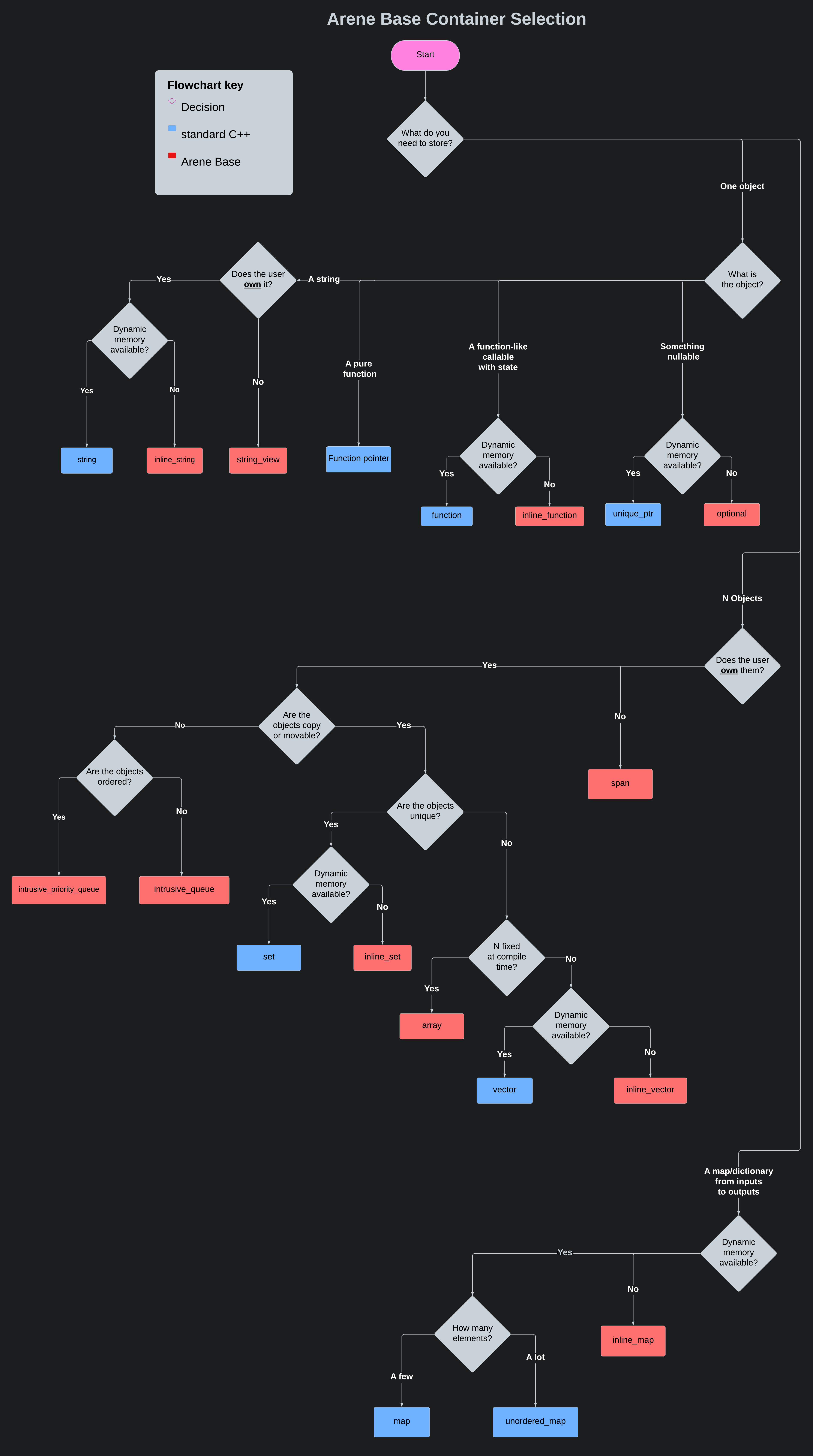
Arene Base offers arene::base::array, which is equivalent to std::array but is designed to be constexpr. Additionally, it is a "checked" type, meaning that operations which would result in undefined behavior (UB) in std::array, such as accessing an index out of bounds using operator[], are transformed into ARENE_PRECONDITION violations.
Additionally, consider using span when appropriate.
It is recommended to use arene::base::array instead of std::array in all cases where the latter is not required by a pre-existing API.
Arene Base offers arene::base::inline_string, a replacement for std::string that does not use dynamic memory allocation. Additionally, it provides the view types arene::base::string_view and arene::base::null_terminated_string_view, which are intended for use as function parameters when you need to consume a string but do not care about its storage location.
It is recommended to use arene::base::inline_string when dynamic memory is not available.
Arene Base provides arene::base::inline_vector, similar to std::vector. Elements are stored "inline" in the vector itself rather than being heap-allocated. This design makes the class suitable for situations where dynamic allocation is undesirable and the size of the container may change. If the container will always contain a fixed number of elements, use arene::base::array instead. The fixed maximum capacity ensures that there is sufficient space for a specified number of elements, preventing unpredictable runtime errors.
It is recommended to use arene::base::inline_vector when dynamic memory is not available.
Arene Base offers arene::base::inline_map, similar to std::map. Elements are stored "inline" in the map itself rather than being heap-allocated. This design makes the class suitable for situations where dynamic allocation is undesirable. The fixed maximum capacity ensures that there is sufficient space for a specified number of elements, preventing unpredictable runtime errors.
It is recommended to use arene::base::inline_map when dynamic memory is not available.
Arene Base provides arene::base::inline_set, similar to std::set. Elements are stored "inline" in the set itself rather than being heap-allocated. This design makes the class suitable for situations where dynamic allocation is undesirable. The fixed maximum capacity ensures that there is sufficient space for a specified number of elements, preventing unpredictable runtime errors.
It is recommended to use arene::base::inline_set when dynamic memory is not available.
Arene Base offers arene::base::inline_function, an implementation of a type-erased invocable similar to std::function. inline_function has the distinction that it never performs dynamic allocation. Instead, it uses an internal buffer for storage, and attempts to store invocables that exceed the internal buffer's size will result in a compilation error.
The decision on which function type to use is highly dependent on the cirucumstance. Some guidelines for the possible options are:
arene::base::function_ref is ideal if you are not intending to store the invocable, as nothing is copied. Storing it for later will lead to undefined behaviour in many cases (e.g. with lambdas) as the referenced invocable will have been destroyed. Still adds an indirection, but only copies a pointer.arene::base::inline_function allows storing any movable invocable with the right signature. Copies the invocable into storage, which must be big enough. No dynamic memory allocation. Adds an indirection vs a template arg.std::function allows storing any movable invocable with the right signature. Copies the invocable into dynamically-allocated storage. Adds an indirection vs a template arg.Intrusive containers serve as alternatives to standard library containers by not storing the values of the elements provided by the user. Instead, the linking structure of the container is stored in the elements themselves, and the container merely provides a standardized way to traverse it.
Intrusive containers offer benefits such as improved performance and memory efficiency but require careful memory management from developers. The containers are also unbounded: there is no maximum capacity, and the container itself does not need to hold storage for the elements.
See more information in the intrusive containers documentation.
Arene Base offers arene::base::intrusive::queue, a singly-linked list-based intrusive queue data structure. It forms a logical FIFO queue, allowing elements to be added at the end and removed (popped) from the front.
This is similar to a std::queue with std::forward_list as the Container template parameter.
It is recommended to use arene::base::intrusive::queue when dynamic memory is not available.
Arene Base provides arene::base::intrusive::priority_queue, a max-heap-tree-based intrusive priority queue data structure. It forms a logical priority queue, allowing elements to be added and removed while providing access to the element with the highest priority, as determined by the comparator.
It is recommended to use arene::base::intrusive::priority_queue when dynamic memory is not available.
Both the C++ Standard Library and Arene Base provide a variety of components for performing algorithmic operations on containers and other sequences.
Just as with the data structures, the Arene Base components provide features not present in the C++14 Standard Library:
constexpr versions of C++14 algorithms, where the C++14 implementation is not constexpr.ARENE_PRECONDITION to check the preconditions are met, where this is possible in a reasonable fashion. For example, indices are always checked for being in-range, but a precondition that a sequence is in sorted order would not be checked.Where there is an Arene Base implementation of a given algorithm, it is recommended to use that in preference to the equivalent version from the C++ Standard Library in all cases. For this reason, the Arene Base implementation of the C++ Standard Library often does not contain implementations of algorithms where there is a version of that algorithm present in the arene::base namespace.
This flowchart will help you choose the appropriate algorithm for a given purpose.

"Selecting an algorithm"
The following sections describe the Arene Base algorithms, and how they differ from the equivalent C++ Standard Library versions.
The all_of algorithm checks if all of the supplied values are true, or all the results of applying the given predicate to the each of the supplied values are true.
The Arene Base implementation of arene::base::all_of is usable in constexpr contexts in C++14, whereas the C++ Standard Library implementation is not usable in constexpr contexts prior to C++20.
In addition, the Arene Base implementation provides an overload that takes any number of bool parameters, and an overload that takes a std::initializer_list<bool> holding the values to check. These overloads are also usable in a constexpr context.
The any_of algorithm checks if any of the supplied values are true.
The Arene Base implementation of arene::base::any_of is usable in constexpr contexts in C++14, whereas the C++ Standard Library implementation is not usable in constexpr contexts prior to C++20.
In addition, the Arene Base implementation provides an overload that takes any number of bool parameters, and an overload that takes a std::initializer_list<bool> holding the values to check. These overloads are also usable in a constexpr context.
Arene Base does not provide an overload that takes a predicate.
The clamp algorithm ensures that a value is within a specified range. The return value is equal to the source if it is in range, the lower limit if the source is below the lower limit, and the upper limit if the source is above the upper limit.
The Arene Base implementation of arene::base::clamp is usable in constexpr contexts, and available even in C++14, whereas the C++ Standard Library implementation is not available at all prior to C++17.
The copy algorithm copies a series of elements from a source range to a destination range.
The Arene Base implementation of arene::base::copy is usable in constexpr contexts in C++14, whereas the C++ Standard Library implementation is not usable in constexpr contexts prior to C++20.
The copy_if algorithm copies a series of elements that satisfy a predicate from a source range to a destination range.
The Arene Base implementation of arene::base::copy_if is usable in constexpr contexts in C++14, whereas the C++ Standard Library implementation is not usable in constexpr contexts prior to C++20.
The equal algorithm compares two ranges to see if they have the same size and the corresponding elements from each range are equal.
The Arene Base implementation of arene::base::equal is usable in constexpr contexts in C++14, whereas the C++ Standard Library implementation is not usable in constexpr contexts prior to C++20.
The fill algorithm assigns the same value to every element in a sequence.
The Arene Base implementation of arene::base::fill is usable in constexpr contexts in C++14, whereas the C++ Standard Library implementation is not usable in constexpr contexts prior to C++20.
The find algorithm returns the iterator referencing the first element in the supplied range that is equal to the given element, or the end of the range if there is no equal element.
The Arene Base implementation of arene::base::find is usable in constexpr contexts in C++14, whereas the C++ Standard Library implementation is not usable in constexpr contexts prior to C++20.
The find_if algorithm returns the iterator referencing the first element in the supplied range for which invoking the supplied predicate returns true, or the end of the range if there is no such element.
The Arene Base implementation of arene::base::find_if is usable in constexpr contexts in C++14, whereas the C++ Standard Library implementation is not usable in constexpr contexts prior to C++20.
The iter_swap algorithm swaps the elements referred to by two iterators.
The Arene Base implementation of arene::base::iter_swap is usable in constexpr contexts in C++14, whereas the C++ Standard Library implementation is not usable in constexpr contexts prior to C++20.
The lexicographical_compare algorithm compares two ranges, returning true if the first is before the second in a lexicographical ordering, false otherwise. The ordering is checked using the supplied comparator, or std::less<> if none is supplied.
The Arene Base implementation of arene::base::lexicographical_compare is usable in constexpr contexts in C++14, whereas the C++ Standard Library implementation is not usable in constexpr contexts prior to C++20.
The lexicographical_compare_three_way algorithm compares two ranges, returning arene::base::string_ordering to indicate if the first is less than the second, equal to the second, or greater than the second, in a lexicographical ordering. The ordering is checked using the supplied three-way comparator, or arene::base::compare_three_way if none is supplied.
The Arene Base implementation of arene::base::lexicographical_compare_three_way is usable in constexpr contexts in C++14, whereas the C++ Standard Library implementation is not available at all prior to C++20.
The Arene Base implementation always returns arene::base::strong_ordering, since Arene Base doesn't currently provide a weak ordering comparison result type, whereas the C++20 standard library implementation returns std::strong_ordering or std::weak_ordering as appropriate for the comparison.
The move algorithm moves a series of elements from a source range to a destination range.
The Arene Base implementation of arene::base::move is usable in constexpr contexts in C++14, whereas the C++ Standard Library implementation is not usable in constexpr contexts prior to C++20.
The move_backward algorithm moves a series of elements from a source range to a destination range. The ranges are iterated in reverse, so the last element is moved first.
The Arene Base implementation of arene::base::move_backward is usable in constexpr contexts in C++14, whereas the C++ Standard Library implementation is not usable in constexpr contexts prior to C++20.
The rotate algorithm rotates a range so that the specified "middle" element is now the first element, and the elements that were originally prior to the "middle" element have been moved to the end.
The Arene Base implementation of arene::base::rotate is usable in constexpr contexts in C++14, whereas the C++ Standard Library implementation is not usable in constexpr contexts prior to C++20.
The sort algorithm sorts a range of elements into order, according to the supplied comparator, or std::less<> if no comparator is provided.
The Arene Base implementation of arene::base::sort is usable in constexpr contexts in C++14, whereas the C++ Standard Library implementation is not usable in constexpr contexts prior to C++20.
The swap_ranges algorithm swaps the elements from one range with the corresponding elements of a second range.
The Arene Base implementation of arene::base::swap_ranges is usable in constexpr contexts in C++14, whereas the C++ Standard Library implementation is not usable in constexpr contexts prior to C++20.
The transform algorithm applies an invocable to each element in a range, and stores the result of that invocation in the corresponding element of the destination range.
The Arene Base implementation of arene::base::transform is usable in constexpr contexts in C++14, whereas the C++ Standard Library implementation is not usable in constexpr contexts prior to C++20.
The Arene Base implementation provides additional overloads which applies the invocable to the elements of a std::tuple, std::pair or std::array rather than an iterator range, returning a new std::tuple, std::pair or std::array as appropriate, holding the results of those invocations.
 1.13.2